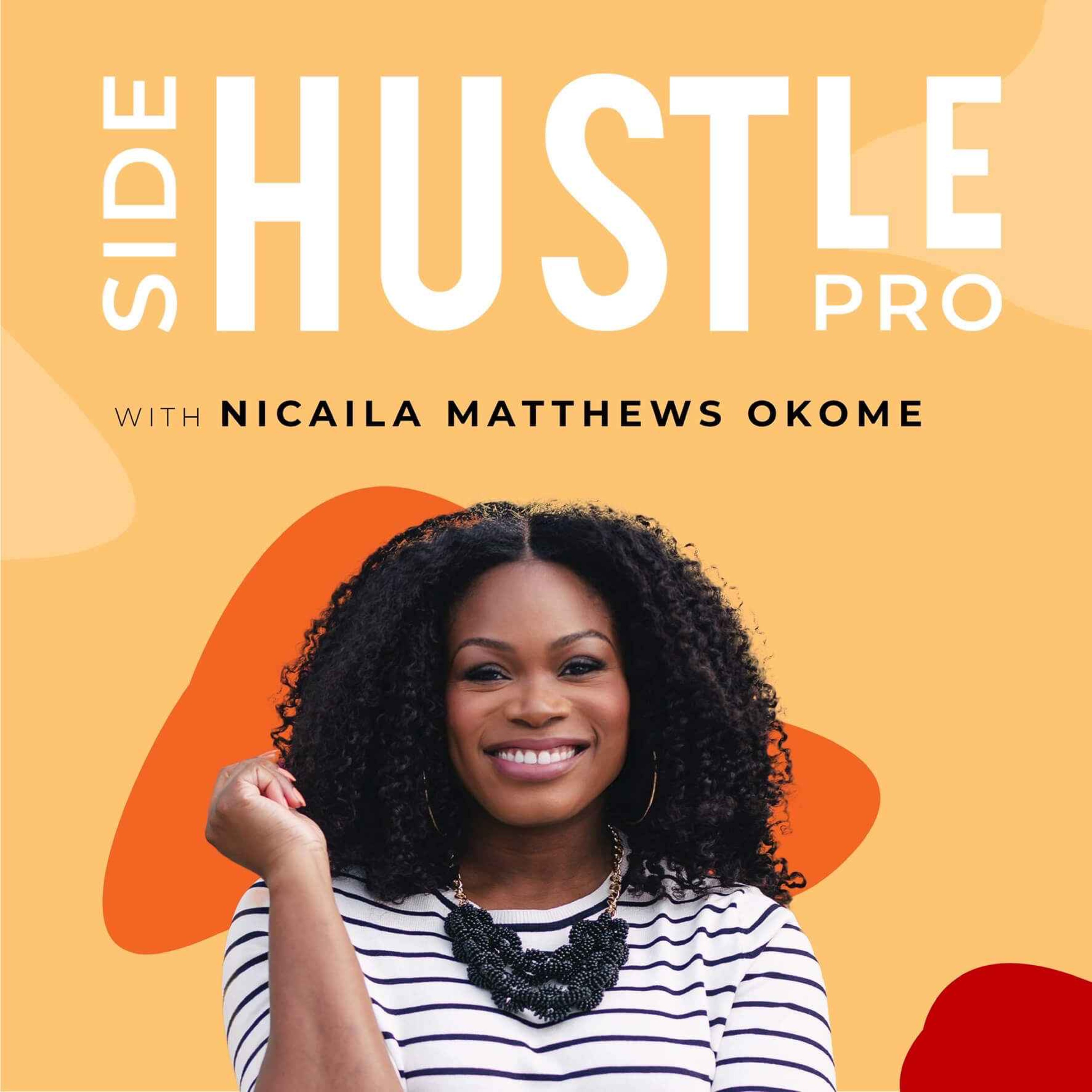
495: Breaking My Own Glass Ceiling
December 31, 2025
Key Takeaways Copied to clipboard!
- Entrepreneurship inherently lacks stability, making side hustling a necessary way to maintain financial security and explore personal interests.
- Self-imposed barriers, often rooted in childhood experiences like unequal educational opportunities, manifest as fear, imposter syndrome, and negative self-talk that must be actively countered by 'talking back' to the fear.
- Black women entrepreneurs often struggle with internalizing societal pressures (like white patriarchal standards) which leads to judging other Black women, a cycle that requires stepping away from limiting environments to recognize and break.
Segments
Intro and Episode Context
Copied to clipboard!
(00:00:22)
Copied to clipboard!
- Key Takeaway: Side Hustle Pro is re-airing a special interview from the ‘To Tell You The Truth’ podcast as a reprise episode.
- Summary: Host Nikayla Matthews Okome announces the episode is a special swap featuring an interview by Brittany Sharpton. This episode addresses self-imposed barriers, particularly for Black women entrepreneurs. The host is taking a rest, using this time to share favorite past content with listeners before the show’s 10th anniversary year in 2026.
Host’s Corporate to Entrepreneur Journey
Copied to clipboard!
(00:05:20)
Copied to clipboard!
- Key Takeaway: Nikayla’s journey involved navigating culture shock from the Bronx to UPenn and realizing the lack of true stability in corporate jobs, leading to the start of her blog/podcast.
- Summary: The host grew up in the Bronx, attended Bronx Science, and experienced culture shock at the University of Pennsylvania, which reinforced the need for self-affirmation. After earning an MBA, a failed full-time offer at Google led her to side hustling in D.C. in 2015, eventually leading to her full-time career as a podcaster and educator after working at NPR.
Identifying Self-Imposed Barriers
Copied to clipboard!
(00:11:47)
Copied to clipboard!
- Key Takeaway: The biggest hurdle for many is the mental barrier of believing stability exists in a 9-to-5 job, when in reality, everyone needs a side hustle due to systemic insecurity.
- Summary: The conversation emphasizes that there is no true stability in corporate employment, citing recent tech layoffs as evidence. People often tell themselves ’no’ regarding their passions, creating mental barriers that are more limiting than external factors. Barriers exist across life facets, including career and relationships, and require evaluating real barriers versus self-imposed ones.
Cognitive Biases and Mental Reprogramming
Copied to clipboard!
(00:14:11)
Copied to clipboard!
- Key Takeaway: Automatic negative thoughts can be scientifically addressed by retraining the brain, recognizing cognitive biases like ‘anchor bias’ that inform business decisions.
- Summary: Listening to resources like Mel Robbins’ podcast helps listeners understand the science behind retraining automatic negative thoughts to be more optimistic. Cognitive biases, such as anchor bias, show how initial information shapes current opinions and decisions, but these can be reset once recognized. Recognizing and addressing these mental hurdles is difficult but necessary for overcoming blockages.
Representation and External Pressure
Copied to clipboard!
(00:16:25)
Copied to clipboard!
- Key Takeaway: The importance of representation is often downplayed, as seeing successful figures like Simone Biles provides tangible proof of possibility for younger generations.
- Summary: The pressure to assimilate to European standards, often stemming from corporate environments, causes Black women to project perfection onto others, such as criticizing Simone Biles’ hair during athletic performance. This internal judgment stems from the need to avoid looking ‘out of place’ to the dominant white society, a burden that must be consciously rejected. Stepping away from corporate environments helps remove the lens of employer perception that limits one’s actions.
Overcoming Funk and Maintaining Energy
Copied to clipboard!
(00:26:37)
Copied to clipboard!
- Key Takeaway: Changing scenery, even through simple walks or short trips, is a vital tool for shaking off a creative or professional funk and reconnecting with one’s core purpose (‘why’).
- Summary: The host felt out of place at Essence Fest initially due to not being an invited speaker, but the environment helped her remember her ‘why’—amplifying Black women’s stories. Changing scenery helps reset the nervous system and allows for the stillness required for new ideas to surface. For entrepreneurs, maintaining energy requires proactive mental health care, as the journey is often lonely.
Dealing with Fear and Imposter Syndrome
Copied to clipboard!
(00:43:32)
Copied to clipboard!
- Key Takeaway: Fear is a constant presence in entrepreneurship, but it can be managed by actively ’talking back’ to the negative thoughts and affirming one’s own heavy-hitter status.
- Summary: The host views fear as an ongoing challenge that requires actively talking back to it, similar to addressing the devil, by countering ‘what if’ scenarios with positive outcomes. The host’s imposter syndrome originated in 7th grade when she realized peers in a specialized program knew advanced math she had never seen, leading to a decades-long fear of looking ‘dumb.’ Unpacking these origins and recognizing that nervousness is not a ‘syndrome’ is crucial for moving past blockages.
Mental Health and Essential Resources
Copied to clipboard!
(00:47:17)
Copied to clipboard!
- Key Takeaway: Regular therapy is essential for entrepreneurs, especially Black women, functioning as a necessary ’trainer for the mind’ rather than a sign of being broken.
- Summary: The host suggests that getting regular therapy is a key strategy for managing anxiety and mental load, comparing it to having a regular health professional rotation. The host recommends feeding the soul with timely resources, citing Jen Sincero’s ‘You Are a Badass’ for mastering the mental game. Other recommended resources include Sheila Johnson’s memoir ‘Walk Through Fire’ for future vision and ‘Get Good With Money’ as a practical manual for financial planning.
0:00 / 0:00